
A growing number of jurisdictions around the world now permit some level of cannabis commerce, especially medical cannabis commerce. While industry rules and regulations vary from market to market, a consistent requirement pertains to packaging.
Legal cannabis industry products are almost always required to be contained in child-resistant packaging, and packaging typically has to adhere to certain labeling requirements that list, among other things, harvest information and lab testing results.
That is all in addition to standard packaging-focused branding and marketing strategies aimed at making packaging appealing to consumers and patients when they see products on dispensary and other retailers’ shelves. When combined with the exponential growth of the emerging legal cannabis industry, the cannabis packaging sector is expected to increase in value for the foreseeable future.
“The global cannabis packaging market size is expected to be worth around USD 24.6 billion by 2034, from USD 3.2 billion in 2024, growing at a CAGR of 22.6% during the forecast period from 2025 to 2034.” stated Market.us in a recent cannabis packaging sector analysis.
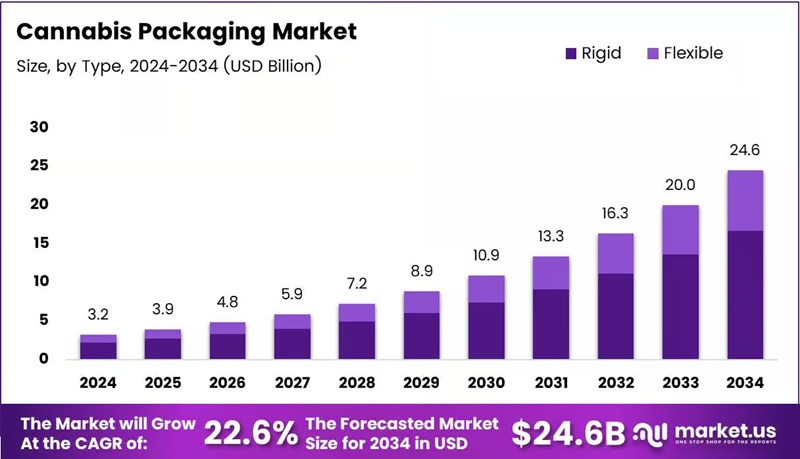
Market.us also determined the following in its cannabis packaging economic analysis:
- Rigid packaging holds a 65.9% market share due to demand for secure and durable packaging.
- Recreational packaging held a 51.3% market share in 2024.
- Plastic was the leading material in the cannabis packaging market, accounting for 51.9% of the market share in 2024.
- Bottles & jars held a 49.2% market share, driven by demand for secure and fresh-preserving packaging.
- North America held the largest market share of 69.2%, valued at $2.2 billion in 2024.
Adult-use cannabis commerce is currently permitted at a national level in Uruguay and Canada. Recreational cannabis sales are also permitted in nearly two dozen states in the U.S., and at a regional level via research-based pilot trials in the Netherlands and Switzerland.
Malta, Luxembourg, Germany, South Africa, and the Czech Republic have also adopted national adult-use legalization measures, although recreational cannabis commerce remains prohibited or limited in those markets. Dozens of countries around the world currently permit medical cannabis commerce.